|
||
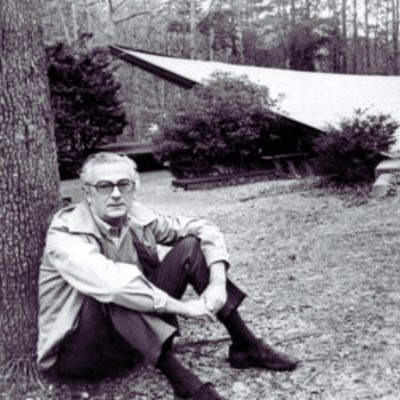
![]() With companion Deborah Forsman. Photo by Daniel Casoy. |
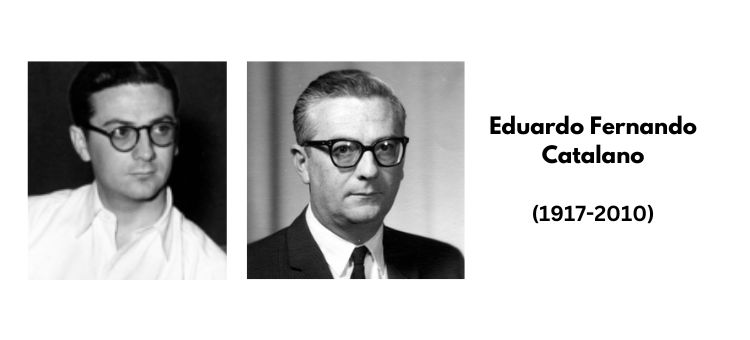
EDUARDO
FERNANDO CATALANO Eduardo Fernando Catalano was born in Buenos Aires, Argentina and came to the United States on scholarships to the Universities of Pennsylvania and Harvard. In 1945, he entered a General Motors design competition using a hyperbolic paraboloid, and won second place out of 914 entries. He was a graduate student of Walter Gropius and an undergraduate student of Marcel Breuer, both professors at Harvard and considered the pioneering masters of modernist architecture. Catalano taught at the Architectural Association in London until 1951 when he was recruited as a Professor of Architecture by Henry Kamphoefner for the NCSU School of Design. In 1956, he moved to Boston and taught at MIT until 1977. Buildings designed by Catalano include the US embassies in Buenos Aires, Argentina and Pretoria, South Africa, the Juilliard School of Music at New York City's Lincoln Center, Guilford County Courthouse in Greensboro (below) and the Stratton Student Center at MIT in Cambridge MA.
One of his NCSU students fondly recalls, "With his thick Argentinean accent, he would tell us the three most important factors in architecture are espace, estructure, and escale." (If this makes no sense, try reading the sentence aloud). Catalano closed his practice in 1995. In 2002, Catalano came out of retirement to design the "Floralis Generica" sculpture in Buenos Aires, a gigantic metal flower with 6 motorized 20-meter-high petals that open and close.
After the untimely death of NCSU College of Design Professor Robert Burns, his former student and employee, Catalano donated $200,000 to NCSU in his honor. Catalano also gave the College of Design a second gift of $400,000 — the largest at the time it was given in 2007 — to establish the Eduardo Catalano Endowed Lecture/Seminar on Innovations in Contemporary Architecture. He was awarded an honorary doctorate by NCSU in 2007. |
|
|
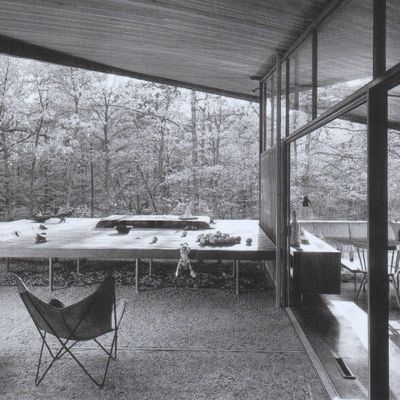
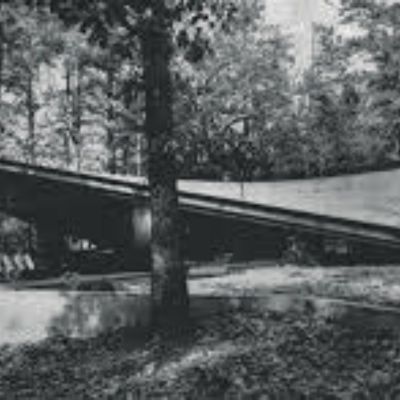
1954 - The Eduardo Catalano House, 1467 Caminos Drive (formerly Ridge Road, now Catalano Drive), Raleigh, the coolest house ever designed in North Carolina and perhaps all of America. He refers to it as the "Raleigh House." The $40,000 house is also called the Ezra Meir House (subsequent owner) or the Potato Chip house because of the swooping hyperbolic roof. Catalano drew this 1700-square-foot home for himself but only lived there a few years. The design was highly publicized as the "House of the Decade" by House and Home Magazine in 1956 and was praised by the rarely praising Frank Lloyd Wright. As with most modernist houses in Raleigh, it was built by Frank Walser. It is the only house Catalano designed in North Carolina. Catalano won a 1965 Honor Award with special commendation from the AIANC. Aerial shot, above, taken in the 1990's. You can see the roof on the left side, at the end of the dirt road. This photo is an early model now on display in the NCSU College of Design Library.
Catalano sold his masterpiece to Ezra and Violet Meir in September 1957. The Meirs sold it to William and Betsy Hinnant in December of 1966.
The Hinnants moved out in 1974 and rented the house to neighbor T. C. Howard after Howard's house burned down. The Howards lived there until the Hinnants sold to Raleigh attorney Arch E. Lynch, Jr. in 1978. Lynch commissioned Karl Gaskins to do an addition but it was never built. Lynch lived there until 1996. From 1996 to 2001, the house was unoccupied. Vandals, storms, lack of heat, and neglect made the house rapidly deteriorate. The roof rotted in sections over time. It would have taken hundreds of thousands of dollars to repair, if repair were even possible. Eventually the damage was too extensive.
Preservation North Carolina bought an option on the house and tried unsuccessfully to sell it for $360,000 to anyone who would rebuild the same design on the site. When no one came forth, Lynch sold to developer JBar Associates in March of 2001. The house was destroyed later that month.
JBar Associates, owned by Andrew Rothschild and Jonathan Bluestone, has since built two large houses on the site (photo above by Leilani Carter).
The Catalano House in its heyday.
The years of decline. Photos from Jetset.
Shortly after its destruction in 2001, Catalano unsuccessfully lobbied to have just the roof rebuilt on the grounds of the NC Museum of Art. Museum trustees were not interested in putting the house close to the museum buildings, which Catalano insisted upon. In early 2005, he proposed a gift of $1.5M rebuild just the roof in the Court of Carolina area of NCSU. Alas, strong faculty opposition and a letter-writing campaign to the News and Observer caused him to withdraw the gift. According to Goodnight Raleigh, "It was a very divisive issue. Lewis Clarke, former professor and head of the Department of Landscape Architecture was incredibly vocal in opposition. He and Will Hooker, a Landscape Design professor, immediately undertook a campaign to stop the pavilion from being built at the Court of Carolinas. It was seemingly pitting the Landscape Architecture/Design camp against the Architecture camp." NCSU hired an architectural firm to evaluate seven other alternative sites but the vocal opposition kept Catalano and his donation in Boston. TMH founder George Smart visited Catalano twice in early 2009 with a new proposal to rebuild the entire house in Raleigh. He got very close to inking a deal, but by summer of that year Catalano rejected the proposed site on Trailwood Drive and turned to NCSU to find something closer to the College of Design. With Catalano's death, the project is again in limbo. |
||
|
1980 - His own house at 44 Grozier Road, Cambridge MA. 3285 sf. Top four photos by George Smart. When put on the market in 2010, it sold in a matter of days to James T. Sherwin. Has since been sold again. Sources include: NCSU School of Design, Preservation North Carolina, News and Observer March 20, 2001, Eduardo Catalano, Adrian Catalano, Ken Friedlein, David Hunt. Recent Past Preservation Network, Jetset, School of Design: The Kamphoefner Years 1948-1973 by Roger Clark, Deborah Forsman, Peter Sugar, Goodnight Raleigh. |
||
![]() |
Website © Copyright 2007-2010
Triangle Modernist Archive, Inc. All Rights Reserved. |